
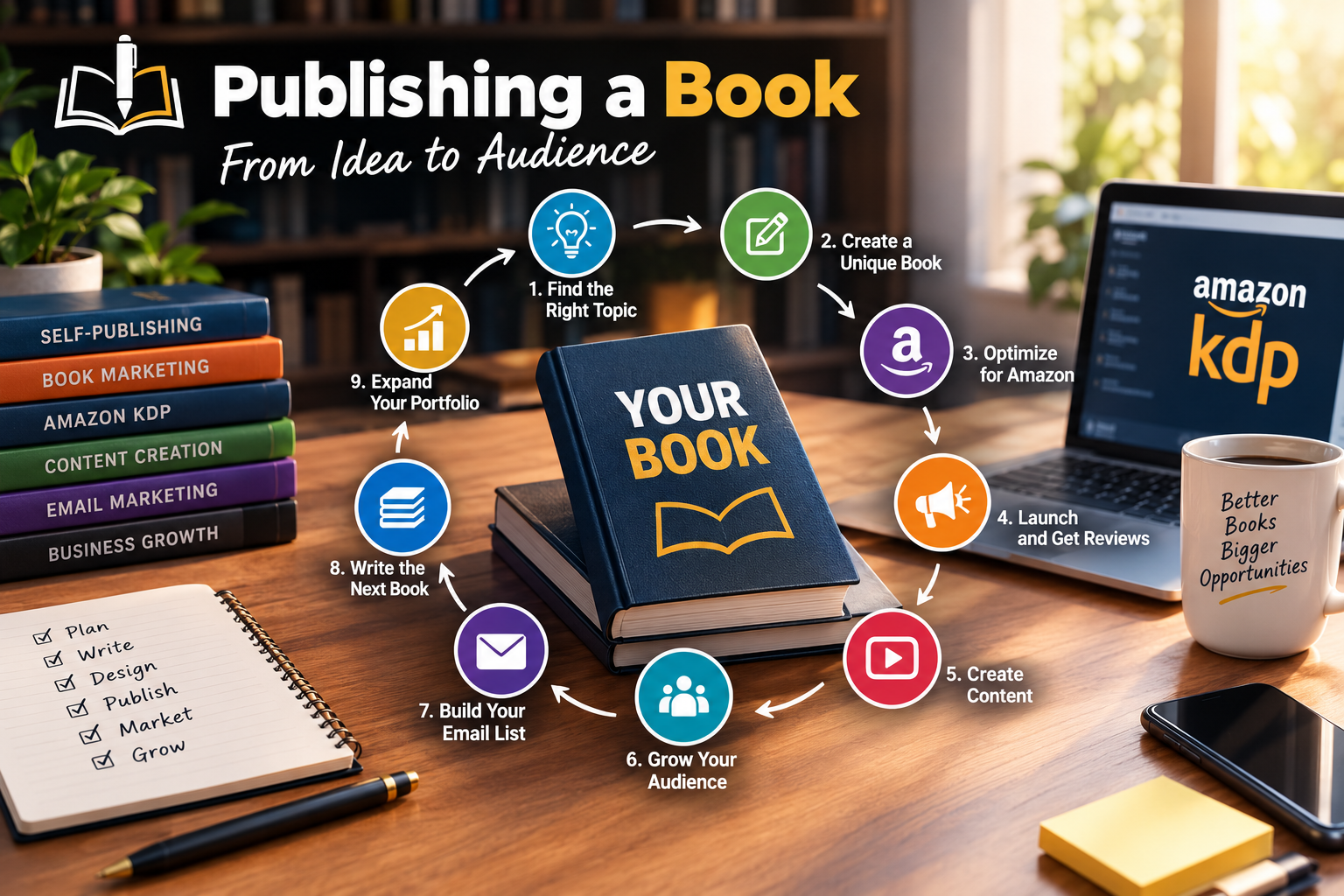
Don’t Just Publish and Wait: Build a Marketing System Around Your KDP Books
Finishing a book and publishing it through Amazon KDP can feel like the end of a long process.
But if your goal is to sell books consistently, publishing may only be the halfway point.
The harder question comes next:
How are readers going to find your book?
After studying different approaches used by people actively working in self-publishing and KDP marketing, one thing stands out: successful book marketing is rarely just about finding better keywords or running more Amazon Ads.
Some publishers start thinking about marketing before they even create the book.
Some build detailed launch plans for the first 30, 60, or 90 days.
Others use TikTok, YouTube Shorts, Instagram Reels, and other platforms to bring outside traffic to their books.
And some think beyond the first sale entirely. They use books to build an email list and an audience that can support future releases.
When you connect these ideas, a much bigger strategy begins to emerge:
A book doesn’t have to be a product you upload to Amazon and wait for people to discover. It can become the center of a larger marketing system.
And that system can begin long before you hit Publish.
1. Before Asking How to Sell a Book, Ask Whether You’re Creating the Right Book
One approach that caught my attention is the idea of creating “The Right Book.”
Instead of starting with:
“What kinds of books are selling right now?”
start by looking for the intersection between two things:
What you know × Problems people want to solve
Think about your professional experience, hobbies, skills, interests, or problems you’ve already learned how to solve.
Then look at the other side of the equation:
Who could benefit from that knowledge?
This is particularly interesting for nonfiction publishers because the book isn’t viewed as a standalone product. The subject of the book can also become the foundation for future content marketing.
If you publish a book about a subject you barely understand and have nothing more to say about, marketing that book over the long term becomes much harder.
But if you have real knowledge, experience, or insight around the subject, the book can become just one piece of a much larger content ecosystem.
Try the “90-Video Test”
One strategy from the material I studied calls this the 90-Video Test.
Before committing to a book idea, try listing short-form video topics related to it.
Can you think of 20?
What about 50?
Could you eventually come up with 90?
The idea is that if you run out of things to say after five or ten topics, the subject may not give you enough material for long-term content marketing.
I wouldn’t treat 90 as a magic number.
The more useful question behind the exercise is:
After I finish this book, will I still have useful things to say to the same audience?
If the answer is yes, one book could potentially generate months of blog posts, YouTube videos, Shorts, Reels, TikToks, emails, and other content.
2. Give Readers a Reason to Choose Your Book
Now suppose you’ve found a promising topic.
There’s another problem.
Amazon may already have dozens, hundreds, or even thousands of books covering the same subject.
Why should someone choose yours?
That’s where a Unique Selling Proposition (USP) becomes important.
Your USP doesn’t have to be revolutionary.
Sometimes the difference comes from adding something genuinely useful.
A book for parents or educators might include an additional teaching guide.
A personal-development book might include worksheets readers can complete as they work through the material.
A fitness journal might include a QR code connecting readers to supplemental exercise videos.
These are examples of ways publishers can make a book more useful or distinctive rather than simply producing another version of what already exists.
And there’s another benefit.
Your USP doesn’t just help differentiate the book on its product page.
It also gives you something worth talking about in your marketing.
3. Position the Book on Amazon
Once you understand:
What the book is → Who it’s for → What problem it solves → Why it’s different
keywords and categories start to make much more sense.
One of the marketing approaches I studied emphasizes buyer intent rather than looking only for keywords with search volume.
That could mean phrases suggesting the reader wants a step-by-step guide for beginners, phrases describing a specific problem such as how to lose belly fat, or phrases identifying a specific audience such as for women over 40.
This changes the way we think about keyword research.
Instead of asking only:
“What are people searching for?”
we can also ask:
“Why are they searching for it?”
What problem are they trying to solve?
What kind of book are they hoping to find?
Who are they?
Keywords are no longer separate from product development.
They become part of the same chain:
Reader → Problem → Book → Search
The same thinking can be applied to categories. The strategy discussed in the source material considers both how closely a category fits the book and the competitive opportunity within that category.
This is why market research doesn’t necessarily have to happen after the book is finished.
What you learn from the market can influence the book you create in the first place.
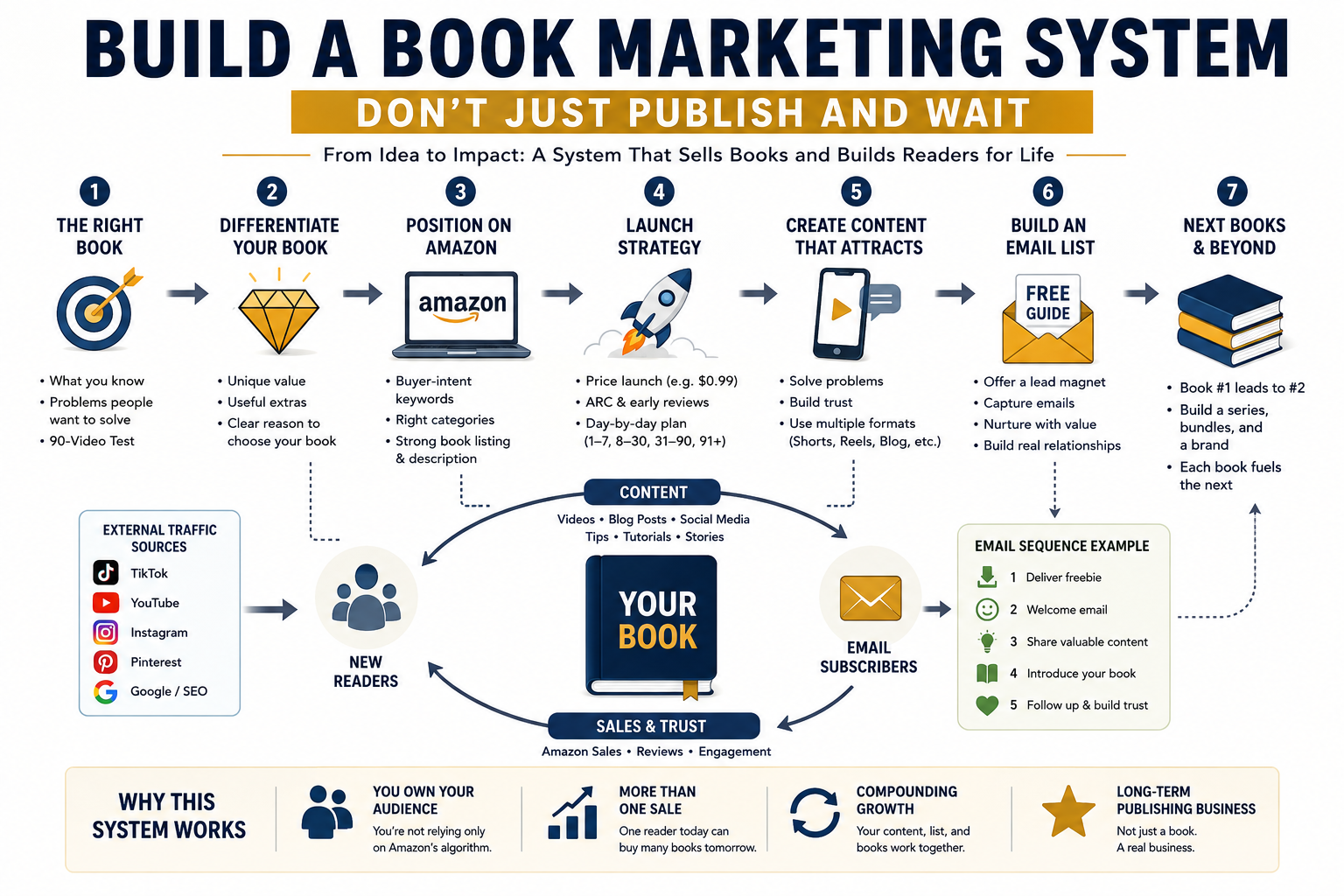
4. Treat Publishing as the Beginning of a Launch
Another interesting pattern is that some KDP marketers don’t simply publish a book and leave it alone.
They build a launch strategy around it.
One approach I studied recommends launching an eBook at $0.99 to encourage early sales, using advance reader copies (ARCs) to get the book in front of readers before or around launch, and actively working to build reviews during the initial launch period.
What makes this approach particularly interesting is the timeline behind it.
The creator lays out a roadmap that looks roughly like this:
Days 1–7: $0.99 launch price + ARC readers + a goal of 10–20 reviews + daily TikTok content
Days 8–30: Begin Amazon Ads + add A+ Content + gradually raise the price to $2.99 or higher
Days 31–90: Scale profitable ads, stop campaigns that aren’t working, continue building reviews, and begin working on the next book
Day 91 and beyond: Create bundles and expand the publishing portfolio
This is one creator’s strategy—not a formula every book should follow.
A $0.99 launch may make sense for one book and not another. The same is true for review goals, advertising schedules, and social media frequency.
But the way of thinking behind the roadmap is worth studying.
There’s a plan for Day 1.
There’s another plan for Day 30.
There’s a plan for Day 90.
And there’s already a plan for what comes after that.
In other words:
Publishing isn’t treated as the final step. It’s treated as the beginning of the launch.
That’s a useful distinction.
5. Amazon Doesn’t Have to Be Your Only Source of Traffic
Once a book is available on Amazon, another strategy is to bring readers in from outside Amazon.
That’s where content marketing enters the picture.
But this doesn’t necessarily mean posting your cover every day with:
“My new book is available on Amazon. Buy it here!”
A much more interesting approach is:
Don’t create content about the product. Create content about the problem the product helps solve.
Imagine that you published a book about learning English.
Instead of opening a video with:
Buy my new English-learning book.
you might start with something like:
You’ve studied English for 10 years. So why are you still afraid to speak it?
Then give the viewer something genuinely useful.
One framework from the source material suggests structuring a hook around:
[Target Audience] + [Pain Point] + [Solution or Reason to Keep Watching]
That changes the path from:
Product → Buy
to:
Problem → Useful Content → Trust → Book
The book becomes the next step for someone who is already interested in solving the problem.
6. One Book Can Generate Dozens of Pieces of Content
This is where the earlier 90-Video Test starts to make more sense.
Imagine publishing a book about Amazon KDP.
That one subject could lead to content about:
Trim sizes.
Bleed.
Paperback vs. hardcover.
Keyword research.
Cover design.
ISBNs.
KDP file errors.
A+ Content.
Pricing.
Common first-time publishing mistakes.
Each idea could become a blog article, a YouTube video, a Short, a Reel, a TikTok, a Pinterest post, or an email.
The book is no longer producing only one product.
It’s creating an entire content universe around itself.
And each piece of content doesn’t necessarily have to be used only once.
Another strategy from the material is batch production and content repurposing—creating short-form videos and adapting the same core content for TikTok, Instagram Reels, YouTube Shorts, and Facebook Reels rather than starting over for every platform.
The equation starts to look very different:
1 Book → Many Topics → Many Pieces of Content → Multiple Platforms
That’s a much more scalable way to think about book marketing than trying to invent a completely new promotional idea every day.
7. Don’t Let Everyone Who Discovers You Disappear
Content can help people discover you.
Amazon can sell your book.
But there’s another question worth asking:
What happens after someone reads your book or watches your content?
Will you ever be able to reach that person again?
This is where two of the marketing approaches I studied begin to connect particularly well.
The answer is an email list.
One strategy recommends creating a lead magnet—something useful that readers can access for free, such as a guide, checklist, template, worksheet, or other bonus resource. The book can then become one of the ways readers discover that resource and voluntarily join the author’s email list.
From there, a simple email sequence might look something like:
Deliver the free resource → Welcome → Provide more useful information → Introduce the book or another product → Follow up
The important shift is that we’re not trying to force every person into an immediate purchase.
Instead, we’re moving through a longer relationship:
Visitor → Reader → Subscriber
And a subscriber may eventually become a reader of Book #2.
8. Your First Book Doesn’t Have to Make Money Only Once
Suppose one person buys your first book.
If the relationship ends there, you made one sale.
But if that book leads the reader to your content or email list, that person may remain connected to your work.
Then Book #2 comes out.
This time, you’re not starting completely from zero.
You already have content.
You may have followers.
You may have email subscribers.
And you have Book #1, which can potentially introduce readers to Book #2.
Once several related books exist, the strategy can expand into series, bundles, and a larger publishing portfolio.
That progression also appears in the roadmap I studied: begin the next book during the 31–90 day phase, then move toward bundles and portfolio expansion after Day 91.
At that point, your books no longer have to operate as isolated products.
Book #1 can introduce readers to Book #2.
Book #2 can lead to Book #3.
Your content can bring new people into the entire ecosystem.
And every book can contribute to building the same audience.
What Happens When We Connect All These Strategies?
This may be the most interesting part.
When you look at each tactic separately, you see a long list:
Keywords.
Categories.
ARCs.
Reviews.
Pricing.
Amazon Ads.
TikTok.
Shorts.
Lead magnets.
Email marketing.
Series.
Bundles.
It can feel like a collection of unrelated marketing tactics.
But once we connect them, a larger system appears:
Market Problem → Right Book → USP → Amazon → Launch → Content → Audience → Email → Next Book → Series / Bundle
And that may be the bigger lesson behind all of these strategies.
Publishers who think this way aren’t asking only:
“How do I sell this book?”
They’re asking:
“How can this book help build a system that makes my next book easier to sell?”
Those questions sound similar, but they lead to very different decisions.
The first question can keep your attention focused on the current book—its keywords, ads, rankings, and sales.
The second makes you think about content, audience, email subscribers, future books, and your entire publishing portfolio.
What Can We Actually Take From These Strategies?
I don’t think the answer is to copy one publisher’s workflow exactly.
A $0.99 launch may be useful for one kind of book and a poor choice for another.
Posting on TikTok every day may work for one publisher and be completely unrealistic for someone else.
One creator’s review target doesn’t have to become your review target.
But there are several questions behind these strategies that are worth borrowing:
Before creating a book, ask: Who is going to buy it, and why?
Before choosing a topic, ask: Can I create useful content around this subject for months—or even years?
Before publishing, ask: What is my launch plan?
After publishing, don’t rely only on people discovering the book organically on Amazon. Ask: Where else can readers discover me?
Once people find your work, ask: How can I continue the relationship?
And before creating the next book, ask:
Can this new book build on the audience, content, and momentum created by the previous one?
That, to me, is the most useful lesson from studying how people in the self-publishing market are actually approaching book marketing.
The goal isn’t to find one perfect formula and follow every step.
The goal is to understand the systems publishers are building behind their book sales, then decide which parts make sense to test in your own publishing business.
Because ultimately, the goal may not be simply to have more books sitting on Amazon.
It’s to make each book create momentum for the next one.
And once that begins to happen, you’re no longer just publishing books and hoping they sell.
You’re building a publishing business.
Sources and Inspiration
This article synthesizes ideas from self-publishing and book-marketing content, including Sean Dollwet’s The Complete Guide to Marketing Your Book on Amazon KDP, which covers approaches to book launches, keywords, categories, reviews, A+ Content, advertising, and portfolio expansion. It also incorporates the Right Book → Content Marketing → Email Marketing framework from the second set of material you collected.
Note: Specific prices, timelines, review targets, launch tactics, and other numbers mentioned above reflect strategies proposed by the creators being studied. They are included because they help us understand how people in the self-publishing market approach their work—not because they are universal rules or a guaranteed formula for success.